The Solar System
One star, eight planets, a belt of leftover rubble and a cloud of ice at the edge — a narrated tour of the whole neighbourhood, with the numbers that make it real.
The Sun
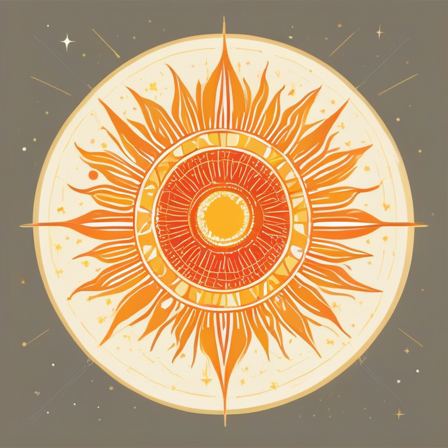
Everything here orbits one ordinary star. The Sun holds more than ninety nine percent of all the mass in the solar system, and it burns about six hundred million tonnes of hydrogen every single second to keep shining.
The rocky inner planets
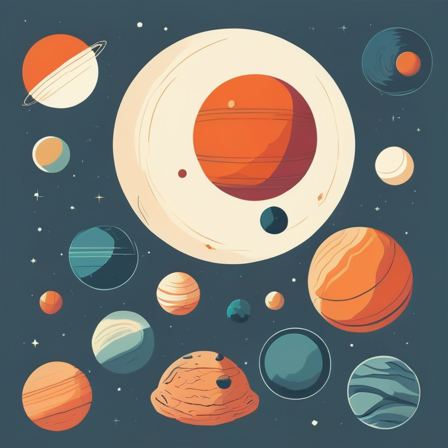
The four planets nearest the Sun are small, dense and built from rock and metal. They are rocky because this close in, the young Sun's heat blew the light gases away and only stone and iron could stay put.
Mercury
Mercury is a scorched ball of iron with almost no air to even out the temperature. Daytime reaches four hundred and thirty degrees Celsius while night falls to minus one hundred and eighty, the biggest swing of any planet.
Venus
Venus is Earth's twin in size and a nightmare in every other way. A thick carbon dioxide blanket traps so much heat that the surface sits at about four hundred and sixty five degrees, hot enough to melt lead.
Earth
Earth is the only world we know where water stays liquid on the surface. It is also the only planet with drifting tectonic plates, which recycle the crust and quietly hold the climate steady over millions of years.
Mars
Mars is about half Earth's width and rusty with iron oxide, which is literally why it looks red. It carries Olympus Mons, a volcano about two and a half times the height of Everest, and dried river channels where water once ran.
The asteroid belt
Between Mars and Jupiter drift millions of leftover rocks that never managed to become a planet, because Jupiter's pull kept stirring them up. Films make the belt look crowded, but the rocks average about a million kilometres apart.
The giant outer planets
Past the belt the planets change character completely. These four are enormous balls of gas and ice with no solid ground to land on, and every one of them carries rings and a private family of moons.
Jupiter
Jupiter is more than twice as heavy as every other planet put together. Its Great Red Spot is a storm wider than the whole Earth, and people have been watching it spin for at least one hundred and fifty years.
Saturn
Saturn's rings are almost pure water ice, spreading two hundred and eighty thousand kilometres across yet often only about ten metres thick. The planet itself is so light for its size that it would float in a big enough ocean.
Uranus
Uranus rolls on its side, tipped over by about ninety eight degrees, probably knocked there by an ancient collision. That tilt gives each pole forty two years of unbroken summer sunlight followed by forty two years of darkness.
Neptune
Neptune is the windiest place we know of, with gales past two thousand kilometres an hour. Sunlight takes four hours to reach it, and one Neptune year lasts one hundred and sixty five of ours, so it has barely finished one orbit since it was found.
Moons
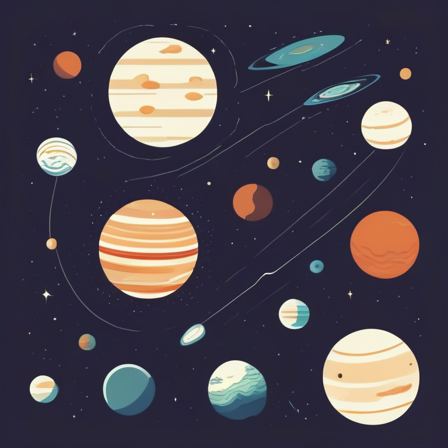
Moons wildly outnumber planets. Earth has one, Jupiter has more than ninety, and Saturn's moon Titan has thick orange air, rain and lakes of liquid methane you could genuinely sail a boat across.
The Kuiper belt
Beyond Neptune lies the Kuiper belt, a broad ring of frozen worlds that includes Pluto. Most short period comets come from out there, and the New Horizons probe still needed nine and a half years just to reach it.
Comets
Those comets are dirty snowballs only a few kilometres wide. When one falls in towards the Sun its ice turns straight to gas without ever melting, and that gas is blown out into a glowing tail millions of kilometres long.
Gravity holds it together
One force ties the whole thing together. Gravity from a single star reaches past Neptune to shepherd eight planets, hundreds of moons and countless icy fragments in patient loops that have been running for four and a half billion years.
Watch it explain itself
Every step above is narrated aloud. Play it, or open it in the editor and make it yours — no account needed.